Sur-Ron Sprocket Gearing Guide: 48T vs 54T vs 58T
Bigger rear sprockets trade top speed for low-end torque. Here's how 48T, 54T, and 58T actually feel on a Sur-Ron or Talaria, and how to pick.
Disclosure: This article contains affiliate links. If you buy through them we may earn a commission at no extra cost to you.
What Rear Sprocket Size Should You Run on a Sur-Ron?
Most Sur-Ron and Talaria owners land on a 54-tooth rear sprocket as the best all-around choice once they've moved off stock gearing — it trades a modest amount of top speed for a meaningful gain in low-end torque, which is where most trail and technical riding actually happens. Riders chasing top speed for open trail or flat dirt roads tend to prefer smaller sprockets in the 44–48T range, closer to stock. Riders towing, climbing steep technical terrain, or running heavier loads (bigger riders, cargo, hill climbs) often size up to 58T or beyond for maximum torque at the expense of a lower top speed. The right size depends entirely on your terrain and riding style, not a single universal answer — this is a tuning decision, not a fixed upgrade.
The Core Tradeoff: Torque vs. Top Speed
No spam. Unsubscribe anytime.
Gearing on an electric dirt bike works the same way it does on a gas bike: a larger rear sprocket means more mechanical advantage (torque) per motor RPM, at the cost of top speed for a given motor speed. Because Sur-Ron and Talaria drivetrains have no clutch and a fixed reduction, sprocket size is the single biggest lever riders have for reshaping how the power delivers.
| Rear Sprocket | Feel | Best For | Approx. Top Speed Impact |
|---|---|---|---|
| 44–48T (stock-ish) | Sharper top end, less low-end punch | Flat trail, open dirt roads, top-speed runs | Highest of the three |
| 54T | Balanced — noticeably more low-end torque, modest top-speed loss | Mixed trail, technical singletrack, most all-around riders | Moderate reduction |
| 58T+ | Strong low-end torque, most top-speed loss | Steep climbs, mud, heavier riders, tow-behind use | Lowest of the three |
These are directional, not exact figures — actual top speed also depends on battery state of charge, controller settings, and rider weight, so treat the percentages as a feel guide rather than a spec sheet promise.
Why 54T Is the Community's Default Upgrade
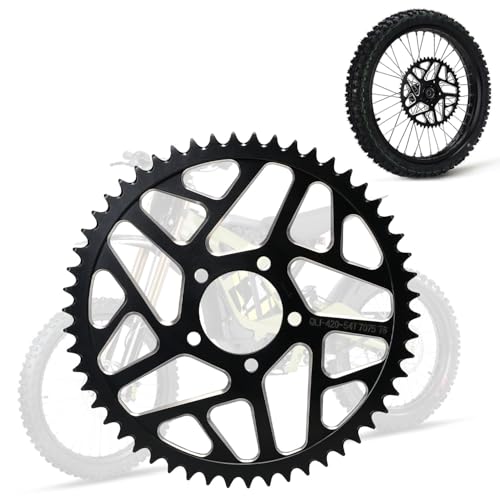
Ask in any Sur-Ron or Talaria forum thread about gearing and 54T comes up more than any other single size — it's popular enough that most aftermarket sprocket vendors stock it as a default option alongside stock-equivalent sizes. The reason is simple: most riders aren't chasing outright top speed, they're riding trail where snappier low-end response matters more for climbing, technical sections, and controlled throttle modulation at low speed. A 54T rear sprocket in 420-pitch, 7075 aviation aluminum, is light enough not to add meaningfully to unsprung rotating mass while still holding up to real trail abuse — see the 54T 420-pitch aviation aluminum rear sprocket for a typical example of what riders run.
Gearing changes only make sense once you're on a chain drivetrain — belts don't offer the sprocket-swap flexibility chains do. If you haven't converted yet, read our belt-to-chain conversion guide first, since that's the prerequisite step.
Matching a Quality Sprocket and Chain Kit
Once you know your target tooth count, sprocket quality matters as much as size. A well-machined kit keeps chain wear even and reduces the chance of the chain jumping teeth under hard acceleration — a real risk with a cheap or mismatched sprocket. The Warp 9 Sur-Ron/Talaria sprocket is a widely-used option in the community specifically because it's built to the bike's actual chain line rather than a generic universal fit. Per widely reported Sur-Ron community builds, mismatched aftermarket sprockets are one of the more common causes of premature chain wear and skipping — a detail worth double-checking against your specific model (Light Bee, Light Bee X, or Ultra Bee) before ordering.
The right sprocket size is a terrain decision, not a horsepower decision — gear down for climbs and technical trail, gear up (toward stock) for open, flat riding.
What About Front Sprocket Changes?
Most gearing conversations focus on the rear sprocket because it's the easier, cheaper swap, but front sprocket tooth count has an outsized effect on final drive ratio per tooth changed — a one-tooth change up front can equal a three- or four-tooth change at the rear. Riders who want fine-grained control sometimes combine a modest rear sprocket change with a front sprocket swap rather than jumping straight to a large rear sprocket. If you're already deep into drivetrain changes, it's worth pairing gearing work with a look at your tire choice, since tire diameter also shifts your effective gearing slightly.
How to Test a New Sprocket Size Before Committing
A sprocket swap is cheap and reversible enough that it's worth treating as an experiment rather than a permanent decision. Ride your usual loop with the stock or current gearing, note how it feels through the technical sections and any long straights, then swap to your target tooth count and ride the same loop again. Riders consistently report that the difference between adjacent tooth counts (say, 48T to 54T) is noticeable within the first few minutes of riding, especially off the line and through tight, low-speed sections — you don't need weeks of riding to form an opinion. Keep the stock or old sprocket on hand; if the new size doesn't suit your terrain, swapping back takes the same amount of time as the original install, generally under an hour with basic hand tools.
Chain Length and Tensioner Adjustments
Changing rear sprocket size shifts the chain's wrap angle slightly, and a larger sprocket in particular can require a longer chain or, at minimum, a retensioning of the swingarm chain adjusters to keep proper slack. Most riders find a one- or two-tooth change doesn't require a new chain length, but jumping from something like 44T to 58T often does. Check your chain's slack against the manufacturer's recommended range after any sprocket swap — running it too tight adds drivetrain wear and stress on the motor output shaft, while running it too loose risks the chain jumping teeth under hard acceleration, which is exactly the failure mode a chain conversion was meant to fix in the first place.
The Bottom Line
Start with a 54T rear sprocket if you're not sure — it's the community's proven middle ground between stock top speed and real trail torque, and it's a cheap, reversible way to feel the difference before committing to something more extreme in either direction.
Affiliate Disclosure